To rapidly improve Digital SAT problem-solving, focus on Desmos mastery, consistent error-logging, and targeted practice instead of aimless test-taking.
Master the Desmos graphing calculator — Use it to solve systems of equations, find intersection points, evaluate inequalities, and find roots of complex quadratics instantly, instead of working through algebra by hand.
Keep an error log — For every missed question, record the exact concept tested, why you missed it, and the correct, most efficient method to solve it next time.
Drill weak areas in the College Board Question Bank — Filter by category, like "Problem-Solving and Data Analysis" or "Algebra," and practice untimed sets until the concepts become automatic.
Practice strategic guessing — Since there's no penalty for guessing, use techniques like working backwards from answer choices or plugging in simple numbers for abstract variables.
Use built-in test day tools — Flag unfamiliar questions and return to them later, and cross out impossible answers to narrow down choices faster.
Improving problem-solving skills in the Math section is key to overall success in the Digital SAT. It requires you to think logically under time pressure, using a solid understanding of math fundamentals. You’ll be breaking down complex questions, analyzing information, and applying mathematical concepts to arrive at the correct solution.
This guide explains actionable strategies that will help you improve problem-solving ability for the Digital SAT. If you are not sure how much help you’ll need, take a free trial Digital SAT to find out.
Understanding Problem Solving in the Digital SAT
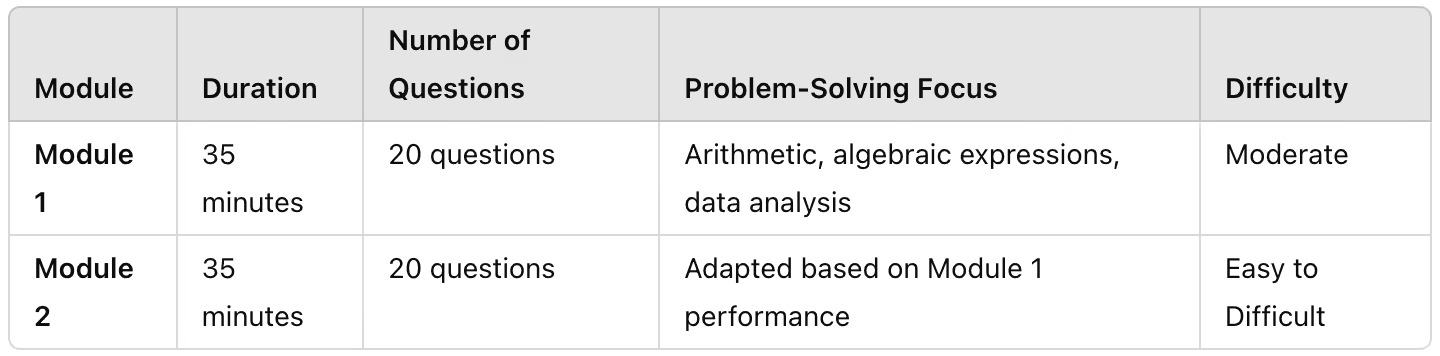
The Digital SAT Math section consists of two modules. The first module has questions of average difficulty level. However, your performance in the first module decides the difficulty level of the questions you’ll see in the second module. If you perform well in the first module, you’ll face more challenging, multi step problem solving questions in the second module.
Problem solving and data analysis questions assess your ability to apply mathematical reasoning to real-world situations. That means you’ll be using charts, graphs, tables, ratios, percentages, and statistical concepts. Instead of memorization, you’ll have to show how effectively you analyze data and identify patterns..
These questions form about 15% of the Digital SAT Math section. Hence, you’ll need to perform strongly in order to achieve a competitive SAT score
Here are the topics covered in this domain:
Topic
Details
Ratios, rates, proportional relationships, and units
May require calculating speed or rate and solving reasoning word problems
Percentages
Assesses your ability to use percentage, fractions and decimals for discounts, markups, or rates of change
One-variable data: distributions and measures of center and spread
Includes mean, median, mode, and standard deviation
Two-variable data: models and scatterplots
Tests the ability to read and interpret scatterplots, and establish relationships between variables
Probability and conditional probability
Requires you to find the probability of events, conditional probability included
Inference from sample statistics and margin of error
Tests your ability to draw conclusions from surveys and samples
Evaluating statistical claims: observational studies and experiments
Asks you to evaluate data claims
Problem Solving questions on the SAT often require multi step reasoning, where you’ll need to connect different concepts to arrive at the correct solution.
ProblemSolving and Adaptive Test Format
Here’s a breakdown of how problem solving is assessed in both modules of the Digital SAT:
Strategies to Improve ProblemSolving for the Digital SAT
1. Master Basic Math Concepts
A strong grasp of fundamental math concepts is essential for solving problems quickly and accurately. Many SAT math questions combine multiple topics into a single problem, so having a solid foundation will help you break down these questions more effectively.
Algebraic Manipulation: Be comfortable with:
simplifying expressions,
solving linear equations, and
working with systems of equations
Ratios and Proportions: These concepts are commonly tested in the Problem Solving and Data Analysis questions. Practice solving problems involving
ratios,
proportions,
percentages, and
rates
Example: Let’s say the question says: ‘A pair of sneakers were first discounted by 20% and then the store raised the price by 20%. Is the final price lower or higher than the original price?’ In such questions of percentage and discounts, it’s best to start by assuming the original price as $100. (A quick tip: If you raise and reduce the price by the same percentage, the final price will always be lower than the original price, no matter what.)
Geometry Basics: Know the formulas for
area,
perimeter,
volume, and
surface area,
properties of triangles, and
circles as well as similar shapes
Trigonometry: If you’re aiming for a high score, make sure to understand the basics of trigonometry, including
sine,
cosine, and
tangent
2. Strengthen Data Interpretation Skills
The Problem Solving and Data Analysis questions require you to interpret and analyze data from charts, graphs, and tables. Being able to quickly understand data presentations is critical for these types of questions.
Identify Trends: When interpreting data, focus on
identifying trends,
spotting patterns and correlations in the information presented, and
making predictions and drawing conclusions based on the data
This helps you answer questions that ask you to make predictions or draw conclusions based on the data.
Practice with Different Graph Types: Become familiar with
reading and interpreting bar graphs,
line graphs,
scatterplots, and
pie charts.
Each type of graph requires a different approach to understanding the data.
Solve RealLife Data Problems: Engage with real-world data sets and solve problems that require you to apply mathematical reasoning to interpret the data. This will improve your ability to handle data driven questions on the SAT.
3. Practice Breaking Down Complex Problems
Many SAT questions involve multiple steps, so it’s essential to learn how to break complex problems into manageable parts. Start by identifying what the question is asking, and then plan the steps needed to reach the solution.
Identify Key Information: Carefully read the problem and underline or highlight important data, such as
numbers,
relationships, or
formulas mentioned in the question
Draw Diagrams: For geometry or word problems, drawing a diagram or visual representation of the problem can help you better understand the relationships between different elements.
Plan Your Approach: Once you have identified the key information
decide on the steps you need to solve the problem
Be mindful of exceptions or limitations, if any
identify the mathematical concepts or formulas needed
EdisonOS offers personalized free practice test modules that focus on breaking down complex math problems step by step. With adaptive feedback, you can improve your problem solving skills and tackle the most challenging SAT questions confidently.
4. Practice with Real SAT Problems
The best way to improve your problem-solving skills is by practicing with real SAT questions. Official SAT practice tests will help you familiarize yourself with the question formats, timing, and difficulty levels you’ll encounter on test day.
Use College Board Practice Tests: The College Board offers official SAT practice tests that simulate the real exam. These practice tests are invaluable for improving your problem-solving skills in realtime, as they mirror the adaptive format of the Digital SAT.
Review and Analyze Mistakes: After completing practice tests, go back and review the problems you got wrong. Analyzing your mistakes helps you understand where you went wrong and how to approach similar problems in the future.
An important side-note: Bluebook tests are the official practice tests for the Digital SAT. To make the best of these tests, use the unmatched Bluebook insights and get ahead.
5. Leverage the Digital Tools Available
The Digital SAT introduces several tools that can help you solve problems more efficiently. Here’s how to make the most of these resources:
Desmos Calculator: The Digital SAT uses the Desmos calculator for the calculator section. It’s important that you familiarize yourself with this tool so that you can
perform complex calculations quickly on test day
know the full functionality of the calculator, and
master the basic tactile ability to move through the buttons swiftly
Digital Highlighting: Use the highlighting tool to mark important details in word problems. This helps you focus on the key information needed to solve the problem without getting distracted by unnecessary details.
Scratch Paper: Even though the test is digital, you will have access to scratch paper. Use it to perform calculations, draw diagrams, or map out your steps when solving more challenging problems.
Scaling Digital SAT Prep for Your Students or Tutoring Center?
See how EdisonOS provides adaptive mock exams, automated error analysis, and custom problem-solving drills to help your students achieve top SAT Math scores.
Not every problem on the SAT requires exact calculations. Learning how to estimate or approximate answers can save you valuable time, especially on complex word problems or data analysis questions.
Round Numbers: When working with large numbers or decimals, round the figures to make calculations easier. Just be sure that the rounding does not significantly affect the accuracy of your answer.
Example:
Let’s say you need to calculate 49.8 × 19.9. First, round them off as 50 × 20 = 1,000.
However, since you’ve rounded both numbers on the higher side (using 50 instead of 49.8), your estimate will be bigger than the actual answer. So, quickly eliminate unrealistic answer choices that equal or exceed 1,000. Finally, choose the one that’s closest to, but smaller than, 1,000.
Eliminate Unlikely Answers: In multiple-choice questions, if you’re unsure of the exact answer, use estimation to eliminate answer choices that are clearly incorrect. This increases your chances of selecting the correct answer.
Remember How Scoring Works: You know how SAT scores are calculated. So don’t be bogged down by one difficult question. Skip or estimate, and move on.
7. Improve Time Management During ProblemSolving
Effective time management is critical in the Digital SAT. You have just over a minute per question in the math section, so learning how to solve problems quickly and efficiently is key.
Prioritize Simpler Questions: Start by answering the questions that you find easier or can solve quickly. This allows you to build momentum and save time for the more complex, multistep problems.
Set Time Limits for GridIn Questions: Gridin questions often take more time than multiple choice questions, so practice solving these types of questions under timed conditions.
Skip and Return: If a problem is taking too long, follow this:
Skip it and return to it later.
When you return, give it your best guess. It’s better than leaving it unanswered.Make sure to keep track of which questions you’ve skipped, so you don’t leave them unanswered at the end.
8. Avoid Common Problem Solving Pitfalls
When practicing problem solving for the SAT, it’s important to avoid common mistakes that can lead to incorrect answers:
Misreading the Question: First, get your facts right. Always check what data is available and what is not.
Read the question carefully.
After that, think of the best solution.
Next, ask yourself if you’re assuming something.
Finally, start calculating.
If time permits, plug the answer into the question and see if all numbers tally.
Not Checking Your Work: If time permits, always double check your calculations and answers. This can help catch careless errors, especially in multi step problems.
Overcomplicating Solutions: Some SAT questions are designed to look more complex than they are. Always check if there’s a simpler way to approach a problem before diving into lengthy calculations.
How Problem Solving is Tested in the Adaptive Digital SAT
Problem Solving questions assess your ability to apply mathematical concepts, interpret data, and solve multi-step real-world problems. The Math section of the Digital SAT has two modules: Module 1 (the base module), followed by Module 2 (the adaptive module).
Most questions in Module 1 will be of average difficulty. If you do well in the Module 1, the Module 2 will have mostly difficult questions (otherwise you’ll get mostly easy questions).
How the adaptive module impacts your scores: Once you get a difficult adaptive module, both your floor and ceiling scores will be higher. In simple words, your scores won’t fall below a certain level, and you stand a chance of scoring a perfect 800. With an easier adaptive module, your score will not reach 800, no matter what. That’s because by serving the easier module, the algorithm has capped your scores.
Practice with Adaptive Digital SAT Mock Tests
Adaptive Digital SAT mock tests build problem-solving skills more effectively than traditional worksheets by replicating the actual exam experience. They provide instant feedback, detailed performance analytics, and targeted practice based on your strengths and weaknesses. This not only helps you improve and accuracy but also develops the confidence needed for test day.
You will need a strong testing platform that delivers accurate SAT-level questions, precisely replicates the test interface, and provides you deep, actionable feedback to improve your performance. You can start your free trial for the Digital SAT and see how strong analytics that lead to personalized practice can help you achieve your dream score.
Why EdisonOS Helps You Improve Digital SAT Problem-Solving Faster
EdisonOS gives you the right tools to improve your Digital SAT Math skills faster. It combines realistic practice with clear feedback, so you always know what to work on next.
Adaptive mock tests that match the Digital SAT format
Bluebook-like test experience for realistic practice
Analytics to identify weak areas
Personalized practice that targets your biggest gaps
Detailed performance insights by topic, skill, time-taken, and more
Heading: Ready to Ace the Digital SAT Math Section?
Get instant access to free adaptive Digital SAT practice tests, step-by-step math breakdowns, and real-time score tracking.
This Is What Sarah M, Senior SAT Prep Director, Says About Us
"EdisonOS completely transformed how our students approach complex SAT Math problems. The adaptive practice and Desmos-aligned questions helped boost our average math score by 90+ points!"
— Sarah M, Senior SAT Prep Director
Conclusion
Improving your problem solving skills for the Digital SAT requires a combination of mastering fundamental math concepts, practicing under timed conditions, and learning how to break down complex problems efficiently.
By practicing with real SAT questions, using digital tools, and honing your data interpretation skills, you can significantly improve your ability to solve problems quickly and accurately on test day. Instead of memorizing formulas, focus on building reasoning skills with consistent adaptive practice that mirrors the real exam.
EdisonOS helps you do exactly that with adaptive mock tests, actionable analytics, and personalized practice designed to improve your Digital SAT Math performance. It focuses on building your problem solving abilities. With real time feedback and targeted practice modules, EdisonOS ensures that you strengthen the skills necessary to excel in the math section of the Digital SAT. It focuses on building your problem solving abilities. With real time feedback and targeted practice modules, EdisonOS ensures that you strengthen the skills necessary to excel in the math section of the Digital SAT.
Frequently Asked Questions
How can I improve my Problem Solving score on the Digital SAT?
What is the best way to practice Digital SAT Problem Solving questions?
How does adaptive testing affect my Digital SAT Math score?
Should I skip difficult Problem Solving questions on the Digital SAT?
How many Problem Solving and Data Analysis questions are on the Digital SAT?
Should I use the Desmos calculator on every Digital SAT Math question?
ABOUT THE AUTHOR
Mayank Batavia
Content Strategist
Mayank Batavia is a freelance content strategist and content writer who writes mostly for tech companies. His background in coaching helps him study and analyse training systems and solutions. He loves memorizing trivia, watching old Westerns, and trying NYT crosswords that he can rarely solve.
Tutors Edge by EdisonOS
Get Exclusive test insights and updates in our newsletter, curated to help tutors stay ahead!
Thanks for subscribing! The 'Digital SAT Breakdown Report' has reached your inbox!
Oops! Something went wrong while submitting the form.














.png)
.webp)
